


One of the most common challenges for adult ADHDers that I see in my UK and online nutritional therapy practice is eating regularly and sticking to it long-term. There are many reasons why adults with ADHD may struggle to stick to a routine with meals, often linked to brain chemistry and core ADHD traits.
Whether it’s forgetting to eat or skipping meals because of hyperfocusing, chaotic mornings trying to get going and be on time or the afternoon crashes that drive sugar cravings, ADHDers may be very familiar with these issues. What is more, ADHD medication may suppress appetite, which may drive urges to overeat or even binge once it stops working.
If this feels all too familiar and you’re craving a way to eat more regularly without relying on rigid meal plans (which rarely work for ADHD brains), this article will guide you through a more realistic, supportive approach. Packed with simple, practical strategies that actually work for ADHD brains, this article is your go-to guide on how to eat regularly with ADHD as an adult.
- Why Is It So Hard to Eat Regularly With ADHD?
- What Happens When You Skip Meals With ADHD?
- What Does “Eating Regularly” Actually Mean for ADHD?
- What to Eat When You Have No Appetite (But Need Energy)
- How ADHD Medication Affects Eating Patterns
- Simple ADHD Meal Systems (Not Meal Plans)
- Common Myths About ADHD and Eating Regularly
- When You Might Need Extra Support
- FAQs: ADHD & Eating Regularly
Why Is It So Hard to Eat Regularly With ADHD?
If you feel like you’re “failing” at the basic human task of feeding yourself, please just know that it has nothing to do with a character flaw and everything to do with impaired executive functioning, as one of the symptoms of ADHD. Studies show that executive and daily life functioning significantly explain mood and functional impairments in adults with ADHD. For the ADHD brain, the path from “I’m hungry” to “I am eating a balanced meal” is full of very real challenges.
Time blindness for ADHDers means two hours can feel like two minutes, and suddenly it’s 4:00 PM and you haven’t had a single bite to eat. If you’re in hyperfocus, your brain effectively mutes the physical signals your stomach is sending. Many of us also struggle with appetite suppression from stimulant medications, which masks hunger until the meds wear off and a ravenous “hunger crash” hits all at once. Throw in the all-or-nothing thinking, where if a meal isn’t “perfect” or “Pinterest-worthy,” it feels easier to just not eat, and you have a recipe for nutritional chaos.
The ADHD Hunger Gap
- Why ADHDers forget to eat: The brain’s “internal clock” is often offline, making it hard to track time since the last meal.
- Why hunger cues get missed: Systematic reviews show that adults in ADHD may have difficulty with interoception (sensing internal bodily states) means you might not “feel” hungry until you’re actually shaky and faint.
- Why crashes happen later: When the brain is deprived of steady glucose, it compensates by demanding high-dopamine, high-sugar foods the moment your focus breaks.
What Happens When You Skip Meals With ADHD?
Skipping meals isn’t just about a rumbling tummy. For someone with ADHD, it’s a fast track to emotional dysregulation and burnout. When your blood sugar drops, your brain loses its primary fuel source, making already-challenging executive functions nearly impossible. This creates even more chaos in an already dysregulated ADHD nervous system.
You might notice you become incredibly irritable or “hangry,” where small inconveniences feel like major catastrophes. Skipping meals is also the biggest trigger for the binge-restrict cycle, especially if you have history with binge eating. By the time you finally do eat, your body is in “emergency mode,” leading to intense cravings and a feeling of being out of control around food.
If you regularly experience binge eating, here are some resources for you to read:
How to Get Out of the Binge-Restrict Cycle
What to Do After a Binge (Without Fasting): How to Recover Physically + Emotionally
What Does “Eating Regularly” Actually Mean for ADHD?
In my nutritional clinic practice, we don’t do “perfection.” For the ADHD brain, the word schedule can often feel like a severe restriction, leading to a “rebel” response where the plan is ditched entirely. When I talk about eating regularly, I’m not talking about a rigid, military-style timetable or meal plans that are impossible for ADHD brains to stick to. I’m talking about flexible structure and gentle regularity.
Think of your meals as regular anchors rather than strict appointments. It’s about gentle consistency, aiming to feed your brain enough fuel to keep your dopamine levels stable and your executive function online. If you miss your “anchor” by an hour, you haven’t failed; you just have something then or you navigate to the next one with ease. It’s about moving away from the “all-or-nothing” mindset and toward a rhythm that supports your unique nervous system instead.
The ADHD-Friendly Eating Rhythm
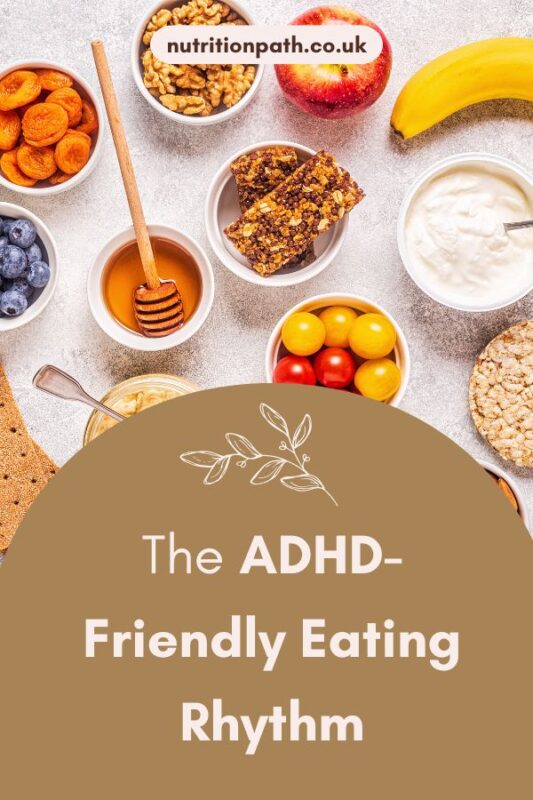
- The 1-Hour Window: Aim to eat within 1–1.5 hours of waking to stabilise blood sugar before the day gets chaotic (even if you don’t yet feel hungry).
- The 3–4 Hour Pulse: Try to have a point of nourishment (meal or snack) every 3–4 hours to prevent the “hanger” crash.
- Protein Power: Include protein at every meal and snack; it’s the building block for the neurotransmitters your brain needs. Studies show that higher-protein breakfasts increase fullness and reduce hunger hormones compared with lower-protein meals or skipping breakfast, which may help curb evening snacking. This supports using protein to stabilise appetite and energy earlier in the day.
- The “No-Thought” Backup: Always have 2–3 “emergency meals” (like a protein shake, Greek yogurt, or a pre-made wrap) for the days when your brain just can’t decide.
What to Eat When You Have No Appetite (But Need Energy)
We’ve all been there: you know you should eat, but the very thought of eating feels overwhelming or “when do I even start?” pops into the mind. Getting out of hyperfocusing or medication-induced lack of appetite is a major struggle for many. When your appetite is offline, the goal shifts from “enjoying a meal fully” to functional fueling.
- Liquid Nutrition: When you don’t yet feel ready to eat but you know your body needs fuel to stay stable, drinking your meals can help. Smoothies with protein powder, full-fat milk (or fortified alternatives), and nut butters are super useful. Even a high-quality pre-made protein shake or a nourishing soup can bridge the gap.
- Low-Volume, High-Density: If you can only manage a few bites, make them count. A handful of walnuts, a spoonful of peanut butter, or a piece of cheese provides more sustained energy than a bowl of plain crackers.
- Gentle Foods: Sometimes “beige” foods like toast, plain pasta, or rice are the only things that feel safe. That’s okay! Boost them with a little butter, hemp seeds, or a side of yogurt to add nutritional “oomph” without the sensory overwhelm.
- Snackable Meals: Abandon the idea of a “plate.” A “muffin tin meal” or a “charcuterie board” (some ham, a few grapes, a bit of cheese, and some nuts) feels much less daunting than a steaming hot dinner.
Check out some related resources for ideas:
- 12 Dopamine-Friendly Snacks for ADHD: Energy, Focus & Fewer Sugar Cravings
- 10 Best Breakfasts for ADHD: Focus, Energy & Fewer Cravings
- ADHD Afternoon Slump: What to Eat for Dopamine and Energy Support & Fewer Sugar Cravings
How ADHD Medication Affects Eating Patterns
If you are on stimulant medication, you’ve likely experienced the “disappearing appetite”, which may mask your hunger cues, just to find yourself ravenously hungry later. Stimulants work by increasing dopamine and norepinephrine, which is great for focus, but these same chemicals can effectively “mute” your brain’s ability to hear your stomach’s hunger signals.
This leads to the classic ADHD medication sandwich: you have zero interest in food at midday, followed by an intense, ravenous evening crash as the medication wears off. This isn’t a lack of willpower, but rather your body screaming for the energy it missed out on for eight hours.
- The “Pre-Med” Breakfast: Eating a high-protein meal before or right as you take your medication is a game-changer. It builds a foundation of energy before the appetite suppression kicks in. Additionally, a small study of college students showed that a nutritionally balanced breakfast can improve cognitive performance, including attention and reaction time, in people with ADHD compared with skipping the morning meal.
- Mechanical Eating: When your internal cues are muted, we rely on external cues. Setting a “lunch alarm” isn’t about being rigid, but rather about consciously providing your brain and body with the glucose it needs to keep your executive functions online.
- Managing the Crash: If you find yourself bingeing at 5:00- 7:00 PM, it’s usually because of “accidental restriction” during the day. Eating small, low-volume snacks during your “medication peak” can soften that evening hunger spike.
Note: I am a Registered Nutritional Therapist, not a doctor. This information is for educational purposes and does not constitute medical advice. Please always consult your prescribing doctor regarding medication side effects or dosage timing.
Simple ADHD Meal Systems (Not Meal Plans)
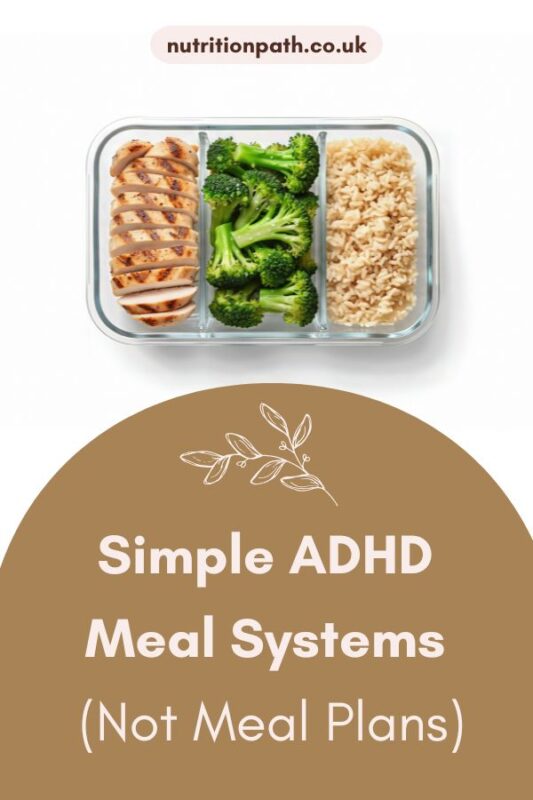
How many meal plans have you tried that felt like they have completely failed? From my clinical and personal experience, meal plans and ADHD don’t mix well together, at least for longer than a few days. They are too rigid and require too much “front-end” executive function. Instead, I teach my clients Meal Systems.
- The 3-Breakfast Rotation: Pick three high-protein breakfasts you actually like (e.g., Greek yogurt with granola, nuts and fruit; eggs on toast with tomatoes and mushrooms or a smoothie protein shake). Don’t decide what to have, but rather just pick one of the three that sounds good today.
- The “Same Lunch for 3 Days” Method: Decision fatigue is real. Prep one protein-dense lunch (like a big tuna pasta salad or a chicken nourish bowl) and eat it for three days straight. By day four, change it up. This is where batch cooking can come in super handy.
- 5 Snack Anchors: Keep five reliable, no-prep snacks in your cupboard at all times (think babybel, protein bars, almonds and fruit, or hummus pots).
- UK Supermarket Shortcuts: If you’re in the UK, using supermarket shortcuts is one of the easiest ways to eat more regularly with ADHD on low-energy days. Don’t be afraid of the “lazy” options. Pre-chopped veg, roast chicken slices, boiled eggs from Waitrose, rotisserie chickens from Sainsbury’s, or M&S balanced prepared meals are ADHD tax well spent if they keep you nourished and out of the binge-restrict cycle with the least energy and headspace to use.
Common Myths About ADHD and Eating Regularly
Myth: “I’m just bad at routines.”
- Reality: You aren’t “bad” at them, your brain just processes “routine” differently. You don’t need a perfect schedule, you need ADHD-friendly scaffolding. Many of my ADHD clients may not be able to stick to a routine with food, but are able to sustain a routine elsewhere (work, exercise, relationships etc).
Myth: “I should wait until I feel hungry.”
- Reality: If you have ADHD or are on ADHD meds, your hunger cues are often unreliable. Waiting for “hunger” often means waiting until you are in a “glucose emergency” state, which doesn’t give you an accurate reading.
Myth: “Skipping meals helps me focus.”
- Reality: While you might feel a temporary “buzz” from adrenaline when fasting, it eventually leads to a cognitive crash that tanks your productivity later, not to mention urges for sweets, bingeing or overeating, that may stall all productivity and just feed the rollercoaster.
Myth: “I’ll eat as soon as I finish this one task.”
- Reality: For an ADHD brain, “one task” can easily turn into four hours of hyperfocus. By the time you finish, you’ve bypassed your hunger cues and landed straight into a blood sugar crash, which makes the next task twice as hard to start. Fueling up actually protects your momentum, even if it means stopping for a little while to refuel.
When You Might Need Extra Support
Many adults with ADHD struggle with irregular eating patterns that worsen focus, mood and cravings. And with ADHD that can feel incredibly lonely, but you don’t have to “white-knuckle” your way through it or google for advice that may feel overwhelming and not stick without experienced human guidance. It might be time to speak to ADHD specialist if:
- Skipping meals has become your usual daily occurrence and it’s having a huge impact on your wellbeing.
- You feel trapped in a painful binge-restrict cycle.
- Your medication side effects are making it impossible to maintain your energy.
- You feel “out of control” around food the moment your focus breaks.
If you want personalised support to eat more regularly with ADHD and nourish yourself for better focus, energy and mood with ADHD, you can explore my ADHD nutrition services or book a free discovery call to see if we’re a good match. I work with adults with ADHD across the UK, Europe, and globally online to help you find food freedom, steady energy and focus and THRIVE with ADHD.

FAQs: ADHD & Eating Regularly
-
How does ADHD affect hunger cues?
ADHD affects hunger through a combination of executive dysfunction and poor interoception (the body’s ability to sense internal signals). When an ADHD brain is in hyperfocus, it essentially “mutes” the physical signals from the stomach. You may not realise you are hungry until your blood sugar has dropped significantly, leading to sudden irritability or a binge episode.
-
Why do I forget to eat with ADHD?
Forgetting to eat is often caused by time blindness, a core ADHD trait where the brain struggles to track the passage of time. Without external reminders, hours can pass without you realising it’s lunchtime. Additionally, if you are taking stimulant medication, the natural appetite cues are suppressed, making it even easier for the brain to bypass the need for food.
-
Can ADHD medication cause binge eating?
The most effective way to break the cycle is through mechanical eating, which means eating at regular intervals (every 3–4 hours) even if you don’t feel “hungry.” By providing your brain with steady fuel, you prevent the extreme “red zone” hunger that triggers a binge. Focus on high-protein “anchor” meals to keep blood sugar stable.
-
How do I stop the binge-restrict cycle with ADHD?
The most effective way to break the cycle is through mechanical eating, which means eating at regular intervals (every 3–4 hours) even if you don’t feel “hungry.” By providing your brain with steady fuel, you prevent the extreme “red zone” hunger that triggers a binge. Focus on high-protein “anchor” meals to keep blood sugar stable.
-
Is there an ADHD-friendly diet?
There is no “perfect” diet as each person is individual, but the most ADHD-friendly approach is one that prioritises simplicity, protein, and consistency. Aim for protein at every meal (to help with neurotransmitter production) and keep “no-thought” meal options available to lower the executive function required to feed yourself.
Further Reading and Resources
- Brandley, E. T., & Holton, K. F. (2020). Breakfast Positively Impacts Cognitive Function in College Students With and Without ADHD. American journal of health promotion : AJHP, 34(6), 668–671. https://doi.org/10.1177/0890117120903235
- Leidy, H. J., Ortinau, L. C., Douglas, S. M., & Hoertel, H. A. (2013). Beneficial effects of a higher-protein breakfast on the appetitive, hormonal, and neural signals controlling energy intake regulation in overweight/obese, “breakfast-skipping,” late-adolescent girls. The American journal of clinical nutrition, 97(4), 677–688. https://doi.org/10.3945/ajcn.112.053116
- Mohamed, S. M. H., Börger, N. A., & van der Meere, J. J. (2021). Executive and Daily Life Functioning Influence the Relationship Between ADHD and Mood Symptoms in University Students. Journal of attention disorders, 25(12), 1731–1742. https://doi.org/10.1177/1087054719900251
4. M Bruton, A., Levy, L., Rai, N. K., Colgan, D. D., & M Johnstone, J. (2025). Diminished Interoceptive Accuracy in Attention-Deficit/Hyperactivity Disorder: A Systematic Review. Psychophysiology, 62(2), e14750. https://doi.org/10.1111/psyp.14750