

Many people assume that constant hunger and “food noise” are simply a lack of willpower. In reality, the surge of interest in medications like Ozempic and Mounjaro has highlighted something I’ve seen for years in my private nutritional therapy practice: for many, the struggle with binge eating and emotional eating is deeply physiological, yet has an element of imbalance in hunger and fullness signals. This is why learning how to increase GLP-1 naturally is becoming such a vital tool, as it allows us to address the biological “volume” of hunger and regain control over our eating habits without relying solely on pharmaceutical intervention.
In my work helping clients cease emotional eating and bingeing, I believe in looking beneath the surface. Before turning to injections, it’s empowering to understand that our bodies have an innate system for appetite regulation. We can actually support and “nudge” increase of GLP-1 (Glucagon-like peptide-1) naturally, which is the very hormone these medications mimic, through targeted, evidence-based nutritional strategies.
By focusing on how we nourish ourselves, we can begin to soften the intensity of “food noise” and rebuild a sense of trust with our bodies. That’s exactly why I’m sharing five science-backed ways you can begin to naturally support your GLP-1 production today. Rather than a “quick fix,” it is a way to nourish your system and help break the cycle from the inside out.
What is GLP-1 and Why Does It Matter for Satiety?
Recent reviews (published in January 2025) confirm that GLP-1 is a “dual-action” hormone. It works peripherally by slowing down gastric emptying (keeping food in your stomach longer) and centrally by activating receptors in the hypothalamus to shut down “food noise” and obsessive thoughts about eating.
While this hormone is available as a powerful medication in its isolated form, in my private nutritional practice I always focus on supporting your body’s natural production first, especially when talking about hormones. When we use nutrition to increase GLP-1 naturally, we aren’t just suppressing an urge, but also supporting the biological pathways that manage hunger. This creates a sustainable foundation for weight management and appetite regulation that feels intuitive rather than forced. By working with your body’s innate chemistry, you can quiet the noise and regain a sense of peace and control around your eating habits naturally, without the side effects that medication may come with.
Wonder if weight loss medications can stop binge eating? Find out my thoughts on this in my other blog post about understanding “food noise” and GLP-1s.
5 Ways to Support Natural GLP-1 Production
While medications provide a synthetic surge of GLP-1, your body is perfectly capable of producing its own through specific nutritional triggers. By intentionally selecting foods that support your gut, you can naturally encourage your system to release these satiety signals more effectively. Also notice- perhaps these foods have been missing in your diet for a while?
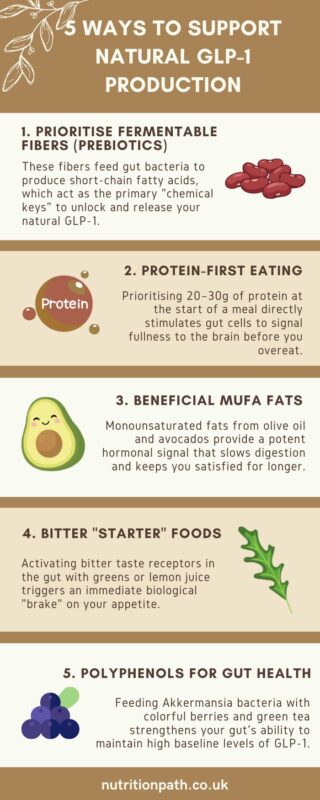
1. Prioritise Fermentable Fibers (Prebiotics)
The Science: Not all fiber is created equal. Fermentable fibers are unique because they aren’t just “roughage”, but serve as fuel and nourishment for your gut microbiome (the beneficial bacteria in your gut). When your beneficial bacteria break down these fibers, they produce Short-Chain Fatty Acids (SCFAs) like butyrate and propionate.
Research published in Nutrients (2023) and updated clinical reviews in early 2025 demonstrate that these SCFAs act as chemical keys that unlock the L-cells in your colon, directly triggering the release of GLP-1 into your bloodstream. This is often referred to as the “Second Meal Effect,” where the fiber you eat at breakfast helps regulate your hunger for the rest of the day.
Action Step: Aim for “fiber-diverse” meals as much as possible and aim for variety. Focus on:
- Beta-glucans: Found in oats and barley.
- Inulin-rich foods: Leeks, onions, garlic, and Jerusalem artichokes.
- Legumes: Lentils, chickpeas, and black beans (the ultimate GLP-1 “powerhouse” foods).
2. Focus on “Protein First” at Meals
The Science: Protein is widely considered the most satiating macronutrient, and recent clinical research clarifies why: it has a direct “hands-on” effect on your gut’s endocrine system. When you consume protein, specific amino acids (like glutamine and arginine) act as direct triggers for the L-cells in the lining of your small intestine. These cells are also the primary producers of your body’s natural GLP-1.
But there’s more! Recent data from a review in Obesity Pillars (2024) highlight how important it is to try “food sequencing.” Research shows that eating protein and fiber before carbohydrates in a meal significantly enhances GLP-1 secretion and slows down gastric emptying. This “protein-first” approach helps create a stable, long-lasting sense of fullness and prevents the rapid blood sugar spikes that can often lead to a binge-restrict cycle.
Action Step: Aim for a target of 20–30g of protein per meal.
The “Protein First” Rule: Start your meal with a few bites of your protein (e.g., Greek yogurt, eggs, chicken, tofu) and your vegetables. This “primes” your satiety hormones to start working before you move on to the starchier parts of the meal.
3. Incorporate Beneficial Fats (Specifically MUFAs)
The Science: For a long time, dietary fat was misunderstood in the context of satiety, but we now know that the type of fat you choose matters so much for hormonal signaling and health. Monounsaturated fatty acids (MUFAs) are particularlyeffective at stimulating the release of GLP-1.
Research suggests that MUFAs, such as those found in extra virgin olive oil and avocados are more potent triggers for GLP-1 secretion than saturated fats. These beneficial fats signal to your small intestine that nutrient-dense food has arrived, which slows down the rate at which your stomach empties and sends a sustained “all is well” signal to your brain. This helps create a smooth, long-lasting sense of fullness rather than the jagged hunger spikes often associated with low-fat, high-sugar diets.
Action Step: Focus on small, consistent additions of high-quality fats to your meals.
- Drizzle extra virgin olive oil over your vegetables or even soup.
- Add a quarter/ half of an avocado to your morning eggs.
- Sprinkle a tablespoon of pine nuts or almonds over your salad for a satisfying “crunch” that supports your GLP-1 secretions naturally.
4. The Power of Bitter Foods
The Science: Your gut isn’t just for digesting, but it is actually lined with bitter taste receptors (known as T2Rs) that are identical to the ones on your tongue. When these receptors are activated by bitter compounds in food, they trigger a “brake” on your appetite by stimulating the immediate release of GLP-1 and CCK (cholecystokinin), another powerful satiety hormone.
In the context of hunger, overeating and binge eating, bitter foods can be a wonderful tool to help “reset” a palate that has been overstimulated by highly processed, sweet, or salty foods. By engaging these receptors, you are essentially giving your gut a head start in signaling fullness to your brain before you’ve even finished your main course.
Action Step: Incorporate bitter foods at the start of your meals to prime your satiety system:
- Leafy Greens: A small side salad of rocket (arugula), radicchio, or kale.
- Citrus: A squeeze of fresh lemon juice in your water or over your fish/chicken.
- Apple Cider Vinegar: A tablespoon of ACV in a small glass of water 10–15 minutes before eating (this isn’t suitable if you have ulcers or other digestive conditions, so please consult your health practitioner first)
- Herbs: Adding fresh parsley or coriander/ cilantro to your dishes.

5. Support the “GLP-1 Bacteria” (Akkermansia)
The Science: Emerging research from 2024 and 2025 has identified a specific strain of gut bacteria, Akkermansia muciniphila, which plays a pivotal role in metabolic health and natural weight management. This bacterium strengthens the gut lining and is directly linked to higher baseline levels of GLP-1 production. A lack of Akkermansia is often found in individuals who struggle with persistent “food noise” and metabolic resistance.
Action Step: You can’t easily “eat” this bacteria separately in a supplement form, but for the biggest effect you want to feed it with specific foods and fibre. It thrives on polyphenols, which are the vibrant compounds that give plants their colour.
- Include deep-colored berries (blueberries, raspberries).
- Sip on high-quality green tea.
- Enjoy some quality extra-dark chocolate (85%+ cocoa).
Mindful Eating in GLP-1 and Satiety Hormone Release
What many people don’t fully understand, and I have this conversation with my nutritional clinic clients (both in UK and online globally) every week is that satiety (and satiety hormones such as GLP-1) react not just to what you eat, but also how you eat.
It takes approximately 15 to 20 minutes for the L-cells in your gut to register that food has arrived and secrete enough GLP-1 to signal the brain. When we eat quickly, we simply bypass this sophisticated hormonal signaling system and the body doesn’t register the food.
By the time the “fullness” signal finally reaches the brain, we may have already eaten way more than what the body actually needs, leading to physical discomfort and shame. Practicing mindful eating like slowing down, chewing thoroughly, and checking in with your physical sensations isn’t just a “nice to do”, but a way to manage hunger and fullness and support the body in the best way. It gives your natural GLP-1 the time it needs to rise, quieten the “food noise,” and help you recognise satiety before the meal is over.
Final Thoughts: How to Increase GLP-1 Naturally
While understanding the science of GLP-1 is empowering, it is important to remember that hunger is rarely just about hormones. We don’t eat in a vacuum, our relationship with food is shaped by our emotions, our history, and the stress of daily life. If “food noise” still feels loud despite your best nutritional efforts, please be gentle with yourself. Biological tools like fiber and protein are foundational, but for many, they are only one piece of a much larger puzzle.
Whether you are navigating the complexities of GLP-1 medications or seeking a natural path to food freedom, you don’t have to do it alone. I have helped hundreds of clients reclaim their headspace and rediscover the joy of eating without fear once again.
Ready to find your balance with food? Take the first step to reclaim your relationship with food, even if you have been binge eating or dieting for years/ decades. Find out about working together or book a free Discovery Call.

FAQs About Natural GLP-1
-
Can you really increase GLP-1 naturally without medication?
Yes. While medications provide a concentrated, synthetic version of the hormone, your body naturally secretes GLP-1 in the L-cells of the gut in response to specific nutrients. By increasing your intake of fermentable fibers, lean proteins, and monounsaturated fats, you can biologically “nudge” your body to produce more of its own satiety hormones.
-
What are the best foods to boost GLP-1?
The most effective foods to help increase GLP-1 naturally include legumes (lentils and black beans), whole grains like oats and barley, and healthy fats like avocado and extra virgin olive oil. Additionally, “bitter” foods like rocket (arugula) and polyphenols found in berries and green tea help activate the gut receptors responsible for hormone release.
-
How long does it take for natural GLP-1 boosters to work?
Unlike medication, which has a half-life of several days, natural GLP-1 release happens meal-by-meal. However, research into the “Second Meal Effect” suggests that eating high-fiber prebiotics at breakfast can improve your satiety and GLP-1 response for the rest of the day. Consistent gut-health habits usually lead to a noticeable reduction in “food noise” within 2–4 weeks.
-
Does protein increase GLP-1?
Yes. Protein is the most satiating macronutrient because it directly stimulates the L-cells in the small intestine. Clinical research indicates that consuming 20–30g of protein, ideally before carbohydrates in a meal, maximizes the secretion of GLP-1 and slows down digestion.
References and Further Reading:
- Patel, S., & Niazi, S. K. (2025). Emerging Frontiers in GLP-1 Therapeutics: A Comprehensive Evidence Base (2025). Pharmaceutics, 17(8), 1036. https://doi.org/10.3390/pharmaceutics17081036
- Wu, S., Jia, W., He, H., Yin, J., Xu, H., He, C., Zhang, Q., Peng, Y., & Cheng, R. (2023). A New Dietary Fiber Can Enhance Satiety and Reduce Postprandial Blood Glucose in Healthy Adults: A Randomized Cross-Over Trial. Nutrients, 15(21), 4569. https://doi.org/10.3390/nu15214569
- Watkins, J. D., Koumanov, F., & Gonzalez, J. T. (2021). Protein- and Calcium-Mediated GLP-1 Secretion: A Narrative Review. Advances in nutrition (Bethesda, Md.), 12(6), 2540–2552. https://doi.org/10.1093/advances/nmab078
- Christensen, S., Robinson, K., Thomas, S., & Williams, D. R. (2024). Dietary intake by patients taking GLP-1 and dual GIP/GLP-1 receptor agonists: A narrative review and discussion of research needs. Obesity pillars, 11, 100121. https://doi.org/10.1016/j.obpill.2024.100121
- Niu H, Zhou M, Zogona D, Xing Z, Wu T, Chen R, Cui D, Liang F and Xu X (2024). Akkermansia muciniphila: a potential candidate for ameliorating metabolic diseases. Front. Immunol. 15: 1370658. https://www.frontiersin.org/journals/immunology/articles/10.3389/fimmu.2024.1370658/full#cite