


I’ve been practicing as a nutritional therapist for nearly a decade, and until recently, “food noise” wasn’t a term I ever heard in my UK and global online clinic. It wasn’t in the textbooks, and it wasn’t in the medical journals. But here is the thing: the moment that phrase entered the cultural lexicon thanks to the rise of GLP-1 medications, every single one of my clients struggling with binge eating and disordered eating knew EXACTLY what it meant. And now you can learn how to reduce food noise naturally, before considering GLP-1 medications.
If you’ve spent years feeling like your brain has a “background narrative” of constant thoughts about your next meal, what you should eat, what you shouldn’t have eaten, how to “fix” tomorrow, you know that noise is exhausting. You’ve likely blamed your willpower, your personality, or your “lack of discipline.”
But I’m here to tell you: It was never a character flaw. It was biology.
The surge of interest in medications like Ozempic and Mounjaro has finally validated what I’ve seen in my nutritional therapy clinic for years: for many, the struggle with binge eating is deeply physiological just as it is psychological. It is an imbalance in the very signals meant to tell us we are safe, satisfied, and full.
We can actually “nudge” our natural production of GLP-1, which is the very hormone these medications mimic, through targeted and evidence-based nutritional shifts.
But let me tell you that this isn’t about a “quick fix” or another set of rules or another diet. It’s about learning how to nourish your system so that the noise naturally softens. Let’s get into the six ways you can start to quiet the mind and support your biology from the inside out.
Wonder if GLP-1 medication can be effective in overcoming binge eating? Check this blog article where I share my clinical thoughts on that.
- Key Takeaways: How to Reduce Food Noise Naturally
- Hunger vs. Food Noise: What’s the Difference?
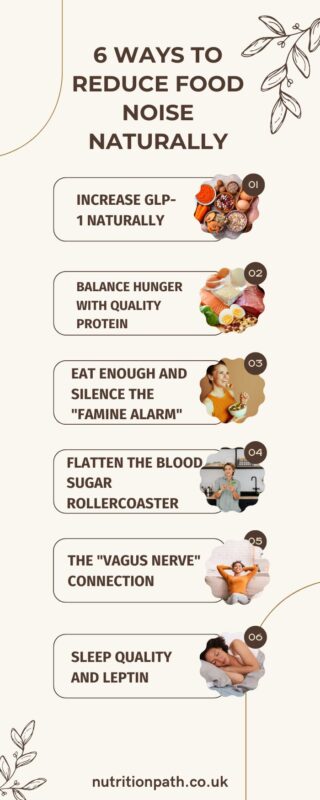
- 1. Increase GLP-1 Naturally
- 2. Balance Hunger with Quality Protein
- 3. Eat Enough and Silence the "Famine Alarm"
- 4. Flatten the Blood Sugar Rollercoaster
- 5. The "Vagus Nerve" Connection
- 6. Sleep Quality and Leptin
- When to Get Professional Support
- FAQs on How to Reduce Food Noise Naturally
Why the Noise Got So Loud (and How to Hear Your Body Again)
Before we dive into the “how-to,” I want to take a moment to explain exactly why your internal signals might feel completely out of whack.
In my clinic, I often see clients who have reached a point where they can no longer distinguish between physical hunger and mental noise. If you have spent years on the “dieting rollercoaster” of jumping from one restrictive plan to the next, your body’s natural hunger and fullness cues will be very out of balance. When you are constantly told what and when to eat by a diet plan/ exercise regime, you stop listening to what your body has to say and stop trusting it.
Eventually, the mind takes over. This is where the “noise” becomes loudest.
Hunger vs. Food Noise: What’s the Difference?
Food noise is the intense, persistent preoccupation with food caused by imbalances in diet regulation, . It is helpful to view “food noise” as a combination of three distinct things:
- Biological Hunger: The physical need for energy (stomach growling, low energy, shakiness).
- Emotional Hunger: Using food thoughts to self-soothe, distract, or cope with stress and big feelings.
- Habitual Reasons: The “autopilot” that thinks about food simply because it’s a certain time of day or because you’re in a specific environment.
For most of my clients, these three are tangled together and it takes a while for us to untangle and understand which one they’re experiencing. When your biology is dysregulated (low GLP-1 or unstable blood sugar), the Emotional and Habitual voices sound like they are shouting through a megaphone.
A Practice, Not a Perfect Streak
As a nutrition therapist, I also want to remind you that “quieting the mind” around food isn’t simply a switch you suddenly flip and all is well, but rather a practice to cultivate over time. There will be days when the noise feels louder due to a poor night’s sleep, a stressful day at work, or raging hormones.
The goal isn’t to reach a state of “perfect silence” where you never think about food again. The goal is to lower the volume enough so that you can actually hear your body’s true signals, respond with compassion, and choose how you want to nourish yourself without feeling like the “noise” is in the driver’s seat.
Let’s look at the six nutritional and lifestyle factors that can help you effectively lower food noise.

6 Biological Anchors to Reduce Food Noise Naturally
There’s no doubt that GLP-1 medications such as Ozempic and Wegowy have changed the conversation in weight loss, BUT they aren’t the only way to turn the volume down. In my nutritional therapy practice, I believe in looking beneath the surface to help you regain the food peace you deserve.
Before turning to medication, there is something incredibly empowering about realising your body has its own innate system for appetite regulation. Sometimes, due to dieting and disordered eating that system can be out of balance. Let’s see how you can reduce food noise naturally by tuning your hunger and fullness dials to work for you..
1. Increase GLP-1 Naturally
Your body is already making GLP-1 naturally, you just need to provide the raw materials to switch the machinery on. While diet culture often views fiber as a way to feel physically stuffed, a sensation that can be quite triggering in binge eating recovery, the real magic of it is the effect on the gut-brain connection. When you eat fermentable fibers found in oats, beans, lentils, and cooled potatoes, as research shows that they act as a natural trigger for your L-cells to release your own natural internal GLP-1 hormone.
Current research (such as studies indexed in PubMed regarding Short-Chain Fatty Acids and Incretin Secretion) highlights that when gut bacteria ferment these specific fibers, they produce metabolites like butyrate and propionate. These aren’t just digestive byproducts, they are signaling molecules that bind to receptors in the colon to trigger the release of natural GLP-1 and PYY (hormones that help you feel fuller). Also, clinical observations of the “Second Meal Effect” show that these fibers improve glucose tolerance and quiet “food noise” not just for the current meal, but for the following one as well.
It’s not about filling your stomach to the point of physical discomfort, but rather about sending a biochemical signal to your brain that the “hunt for food” is over. By nourishing your microbiome (the beneficial bacteria in your gut) this way, you provide your nervous system with the biological reassurance and safety so it can stop sending you signals to search for more food and finally redcuce food noise naturally.
You can read more on other natural ways to increase GLP-1s in my other blog post.
2. Balance Hunger with Quality Protein
If you struggle with disordered eating, physical hunger can feel like a looming threat or a “red alert” that triggers a frantic drive to binge. Rather than viewing protein as a “diet food,” aim to frame it as a biological stabiliser that helps quiet the Ghrelin response, the hormone responsible for that gnawing, “I’m empty” sensation. When Ghrelin is high, your brain is in a state of hyper-vigilance, making food noise almost impossible to ignore.
Current clinical research, including studies published in The American Journal of Clinical Nutrition, clearly show that a protein-rich start to the day (aiming for 25–30g) significantly suppresses hunger levels compared to high-carbohydrate alternatives. By front-loading your protein, you are effectively “dampening the alarm.” This isn’t about restriction, but rather signalling your brain hunger control centre that you are safe and adequately fueled.
Research into the “Protein Leverage Hypothesis” (often cited in journals like Obesity Reviews) suggests that the body will continue to signal hunger and create “food noise” until its protein requirements are met. By prioritising high-quality protein upfront, you satisfy this biological requirement, allowing the mental chatter to fade into the background so you can focus on your day/ life rather than your next meal.
3. Eat Enough and Silence the “Famine Alarm”
This is the most fundamental change to make, because you cannot reduce food noise naturally if your brain thinks you are starving. In the context of disordered eating, food noise isn’t a “lack of willpower”, but rather a survival mechanism. When you under-eat or skip meals, your brain enters the “Famine Mode,” turning the volume knob of food obsession to the maximum to ensure you find energy to stay alive (your body is programmed to help you stay alive!).
Current research in Psychosomatic Medicine regarding the “Restrained Eating” phenomenon highlights that biological restriction, even if unintentional, leads to increased cortisol and a heightened neural sensitivity to food cues. Essentially, restriction “primes” your brain to obsess over food. You cannot achieve “Safety Mode” in the nervous system while your body is in a state of energy deficit.
By consistently nourishing yourself and giving your body enough, you provide the biological safety your body needs to lower the “famine alarm,” allowing to reduce food noise naturally as there’s no more threat to survival!
4. Flatten the Blood Sugar Rollercoaster
When blood sugar levels spike and then crash (reactive hypoglycemia), your brain interprets the rapid drop as a metabolic emergency. This crash triggers an urgent, frantic “food noise” that often feels impossible to ignore, driving you toward quick-energy foods such as sugary, processed foods and caffeine to “save” your system. By focusing on managing glucose spikes rather than counting calories, you can keep your brain in a state of calm stability.
The key is the “Pairing Method” in research: avoid eating carbohydrates “naked.” Pairing carbohydrates with fats or proteins blunts the post-meal glucose response and improves satiety. Adding a fat like avocado to your toast or nut butter to an apple slows down gastric emptying and prevents the sharp insulin spike and the crash that follows. By smoothing out these curves, you prevent the biological “red alert” that leads to a binge, keeping the mental volume of food noise low throughout the day.
5. The “Vagus Nerve” Connection
Food noise is often at its loudest when your nervous system is stuck in a “Sympathetic” (fight-or-flight) state. When you are stressed or anxious, your body prioritises immediate energy over long-term digestion, which can effectively “mute” the satiety signals your gut is trying to send. If the brain feels “unsafe,” it doesn’t process GLP-1 or PYY correctly, leading to a frantic search for food to soothe the system.
Research published in Frontiers in Neuroscience highlights the critical role of the Vagus Nerve in the “gut-brain axis.” This nerve acts as a bidirectional highway, if it is under-stimulated due to chronic stress, your brain physically cannot “hear” the satiety hormones being produced in your digestive tract. Engaging in a simple 3-breath practice before eating can shift you into a “Parasympathetic” (rest-and-digest) state. This lowers cortisol and creates the physiological safety necessary for your brain to finally receive the signal that you are full.
6. Sleep Quality and Leptin
I’ve written my entire master’s thesis on the link between appetite hormones and sleep. So I know really well that one of the most overlooked triggers for intense food noise isn’t what you’re eating, but how you’re sleeping. Just one night of poor sleep can make food noise feel significantly louder the next day. It isn’t a “lack of willpower” that makes you reach for quick-energy sugar when you’re tired; it is a direct biological response to a hormonal imbalance (yes melatonin is a sleep hormone).
A landmark study in the Annals of Internal Medicine found that when people are sleep-restricted for just two nights, their Leptin (the fullness hormone) drops by 18%, while Ghrelin (the hunger hormone) spikes by 28%. This shift creates a massive “hunger gap,” leading to a 45% increase in cravings for high-calorie, carbohydrate-dense foods. By prioritising your sleep, rest and reset you are protecting your brain’s ability to stay in “Safety Mode,” ensuring your hormones are balanced enough to keep the mental volume of food obsession turned down low.
The Bottom Line: Find Peace from Food Noise
If you have spent years feeling like your brain is “broken” because of constant food noise, please hear this: Your body is not your enemy and it is definitely not broken. Food noise is almost always a survival signal, a loud, persistent message from a nervous system that feels under-fueled, over-stressed, or biologically unstable.
While GLP-1 medications can be a helpful tool for some, they aren’t the only way to reduce food noise. By focusing on “Safety Mode” and feeding your gut the right fibres, stabilising your blood sugar, meeting your protein needs, and respecting your need for rest, you are teaching your brain that it no longer needs to scream for survival..
When to Get Professional Support
Healing the gut-brain connection takes time and patience, and for many, the “noise” has deep roots in a history of chronic dieting or disordered eating. In my nutrition therapy clinic, we move beyond just “what to eat” and look at the “why” behind the noise. Together, we can work to overcome binge eating, restore your physical hunger cues and build a relationship with food that feels calm, stable, and safe. You deserve to move through your day without the constant mental volume of food obsession.
👉 Work with Me or Book a Discovery Call
FAQs on How to Reduce Food Noise Naturally
-
What exactly is “food noise”?
Food noise is the constant, intrusive mental chatter regarding food, cravings, and the next meal. Biologically, it often occurs when the brain’s satiety signals (like GLP-1 and Leptin) are drowned out by hunger hormones (like Ghrelin) or a nervous system stuck in “survival mode.”
-
Can you really increase GLP-1 naturally?
Yes. Research published in Nature Reviews Endocrinology shows that eating fermentable fibres (prebiotics) triggers the L-cells in your gut to release endogenous GLP-1. This is the body’s natural way of signalling to the brain that you are satisfied and the “search for food” can stop.
-
Why do I get food noise even after eating?
This is often caused by the “Blood Sugar Rollercoaster.” If a meal is high in simple carbohydrates without enough protein or fat, your blood sugar spikes and then crashes. That rapid drop (reactive hypoglycemia) triggers a “famine alarm” in the brain, creating urgent food noise to get your energy levels back up.
-
How does protein help with binge eating recovery?
Protein is a powerful Ghrelin suppressor. By reaching a threshold of 25–30g of protein early in the day, you satisfy the “Protein Leverage Hypothesis,” which states the body will continue to signal hunger until its amino acid requirements are met. This physically lowers the volume of cravings.
-
Is food noise a sign of a lack of willpower?
Absolutely not. Food noise is a biological response, not a moral failing. It is often the result of chronic restriction, poor sleep, or hormonal imbalances. In nutrition therapy, we treat food noise as a “check engine light” for your metabolism and nervous system, rather than a lack of self-control.
References and Further Reading
- Suzuki, S., & Aoe, S. (2021). High β-Glucan Barley Supplementation Improves Glucose Tolerance by Increasing GLP-1 Secretion in Diet-Induced Obesity Mice. Nutrients, 13(2), 527. https://doi.org/10.3390/nu13020527
- Bartsch, M., Vital, M., Woltemate, S., Bouwman, F. G., Berkemeyer, S. B., Hahn, A., & Müller, M. (2025). Microbiota-Dependent Fiber Responses: A Proof-of-Concept Study on Short-Chain Fatty Acid Production in Prevotella- and Bacteroides-Dominated Healthy Individuals. The Journal of nutrition, 155(11), 3809–3822. https://doi.org/10.1016/j.tjnut.2025.08.034
- Leidy, H. J., Hoertel, H. A., Douglas, S. M., Higgins, K. A., & Shafer, R. S. (2015). A high-protein breakfast prevents body fat gain, through reductions in daily intake and hunger, in “Breakfast skipping” adolescents. Obesity (Silver Spring, Md.), 23(9), 1761–1764. https://doi.org/10.1002/oby.21185
- Simpson, S. J., & Raubenheimer, D. (2005). Obesity: the protein leverage hypothesis. Obesity reviews : an official journal of the International Association for the Study of Obesity, 6(2), 133–142. https://doi.org/10.1111/j.1467-789X.2005.00178.x
- Tomiyama AJ, Mann T, Vinas D, et al. Low calorie dieting increases cortisol. Psychosomatic Medicine. 2010 May;72(4):357-364. DOI:10.1097/psy.0b013e3181d9523c. PMID: 20368473; PMCID: PMC2895000.
- Shukla, A. P., Iliescu, R. G., Thomas, C. E., & Aronne, L. J. (2015). Food Order Has a Significant Impact on Postprandial Glucose and Insulin Levels. Diabetes care, 38(7), e98–e99. https://doi.org/10.2337/dc15-0429
- Breit, S., et al. (2018) Vagus Nerve as Modulator of the Brain-Gut Axis in Psychiatric and Inflammatory Disorders. Frontiers in Psychiatry, 9, 44.
https://doi.org/10.3389/fpsyt.2018.00044 - Spiegel, K., Tasali, E., Penev, P., & Van Cauter, E. (2004). Brief communication: Sleep curtailment in healthy young men is associated with decreased leptin levels, elevated ghrelin levels, and increased hunger and appetite. Annals of internal medicine, 141(11), 846–850. https://doi.org/10.7326/0003-4819-141-11-200412070-00008