

Written by Milda Zolubaite MSc Nutritional Therapist with 9 years of experience helping adults overcoming binge eating and eating disorders and improve ADHD symptoms. In the UK and globally online.
Whether it’s Aunt Jane insisting that you have that last piece of her special lemon drizzle cake or your friends rooting for you to finish your entire Christmas roast at a party to “save room for dessert,” I’m sure you had plenty of encounters with food pushers before.
In fact, nearly 44% of participants in the American Dietetic Association survey reported experiencing pressure from family or friends to eat more than they wanted to. It can also be tricky to do in a marathon of holiday parties.
Do you often struggle to say NO to food and succumb to peer pressure around your food choices? Then it can be useful to come up with some coping strategies to respond to food pushers with assertiveness. These strategies can be incredibly useful to remember and practice if you struggle with your relationship with food and habits.
Whether it’s simply overeating and having a few too many, looking after health and sensibly managing weight or suffering from diagnosed eating disorders, it’s important to assert your boundaries to have an enjoyable time.
Here are a few of my favourite techniques on how to decline food politely and respond to food pushers when you truly have had enough and are feeling the holiday overeating pressure. These strategies can help you stick to your food preferences, especially around the holiday season and tell your family and friends no to food without offending.
As an MSc Nutritional Therapist and Master Practitioner in Eating Disorders for the past 9 years, I routinely share these strategies and scripts with clients in the UK and online worldwide to help reduce binge eating and bulimia around the festive period.
How to Decline Food Politely (a Summary)
- Say “thank you” first
- Be firm and polite
- Use the “broken record” technique
- Use humour
- Offer to take leftovers
- Set boundaries kindly
- Avoid food-focused conversations.

Get your FREE Cheatsheet
9 MINDSET MISTAKES
THAT KEEP YOUR STUCK
IN THE BINGE CYCLE
Why Saying No to Food Pushers Is Hard (Psychological Insight)
It can be hard to say no to food when you’re feeling pressured by a food pusher. To make it easier, try to understand where they are coming from, are they trying to show love and care? Are they just being polite? Are they proud of the food they made and do they seek appreciation?
Understanding why someone is food pushing on you can help you come up with an appropriate response. “Food pushers” are a special breed of humans, that tend to “push” food onto others for various reasons: it could be to show love, cover their insecurities about eating, low self-worth or purely due to learnt habitual patterns.
Take a step back. Remind yourself that this person is probably just trying to show you care and love in their own awkward way. They are not necessarily trying to make you feel uncomfortable or force you into making unhealthy food choices.
Sure, it’s a challenge if you are trying to maintain a healthy diet without sugars or ultra-processed food. Or perhaps you don’t eat a variety of foods that your friends or family eat due to a health condition. Whatever it may be, there are strategies to help to keep you on your health journey. Perhaps even personal conversations with food pushers may be necessary.
When feeling the holiday overeating pressure and wanting to decline food, assertive communication and compassion is key. Embrace the fact that they are likely acting from a place of good intentions, rather than malice. They might be expressing their love, showcasing their cooking skills, or they might just be trying to make you comfortable by applying their unique worldview. It’s crucial to be firm, yet kind in your response.
What is a Food Pusher?
A person who pressures others to eat more food than they want, often from habit, culture, or care.
Simple Strategies to Say NO to Food Pushers During Christmas, Thanksgiving or Holidays
While it can be challenging to decline food politely, understand that it’s completely okay to prioritise your health and dietary needs over the feelings of others. Yes, even if it’s your loved ones or your family.
You have the right to make choices for your well-being. Your physical, mental and emotional health and needs are your priority. Sometimes you may need to say NO to healthy food if your body is clearly letting you know it has had enough.
Therefore, learn to stop people pushing food on you without guilt and stick to your decision. Do it with kindness, patience and a caring self-love. After all, respecting your body and its needs is the highest form of self-care.
When these situations are handled with transparency, clarity and kindness, it is very unlikely that the person on the other end will get upset if you say no to food. And they do, always remember that you have the right to say NO.
Check out some of my favourite strategies and scripts to be transparent and decline food politely this holiday season:
Be kind
For some people offering food and especially treats serves as a way to show deep love, care and appreciation. Although this can be very common with older generation people, especially those who survived wars or poverty, it can also depend on the person’s habits and upbringing.
Be kind, understanding and considerate, as rudely rejecting the food may hurt their feelings and self-esteem. Accept the gesture of love, but turn down the food in a gentle way: “Thank you so much, this looks incredible”, “Wow, everyone will love this” and “Thank you so much, I will certainly have it later.”
Focus on replacing “no” with “thank you’ and aim to complement their efforts and care.
Be firm and assertive
Saying no is a skill that needs to be developed over time, but it requires frequent practice to get comfortable with it, yet remain polite and considerate. Certain techniques can help you to stay assertive without giving in or creating tension in the relationship or the environment at the table.
Assertiveness involves using “I” statements and being transparent and honest about your own feelings. For example, you can say:
- “I am not hungry”
- “I think I have had enough for today”.
“I am not hungry”– This may only work when you are being offered food that’s unplanned and unexpected. The approach of kindness still applies, but you can always explain: “I have just eaten” or “I had enough for now, thank you” or “I wouldn’t enjoy it as much as it deserves as I am full.”
If you are open to tasting or having the offered food later, the person may offer some to take with you. Be prepared to say no (or yes) in that case too.
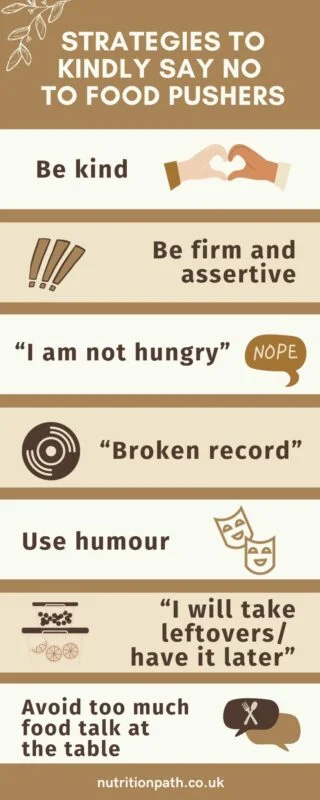
“Broken record”
This is hands down my favourite technique as it demonstrates certainty and communicates your needs clearly, yet still is polite and considerate. “Broken record” is a technique to handle any objections and it stops the likelihood of any justification, explanations and continuation on the topic.
Simply say “No, thank you” with a big smile on your face and if the person insists you have more, just keep saying “no, thank you”. There is great power in simplicity.
However, if you generally don’t feel comfortable saying no, this may feel difficult for you to say and you may feel tense. If you don’t feel confident saying NO, then the person offering you food may sense that and try harder thinking that you’re “just shy” or “you need more encouragement”.
So try to say it loudly and clearly and remember to always stay kind and keep your health goals in the forefront.
Use humour
Humour is a good way to make things light-hearted and diffuse the tension in the situation. Say “thank you” first and if appropriate make a joke that feels right to the situation.
Perhaps turn it towards them and ask: “Sounds like you would like more? Go for it”
This way you will take the pressure off yourself and reassure them it is OK to have some more.
Remember, that some people may want you to eat so they have permission to do so as well. You can praise them for the delicious food, special dishes or snacks you’ve already eaten. Reassure them you would have more if only you had space.
Or make it super light-hearted like “Chips are my FAVOURITE. I’d love to have more room.”
“I will take leftovers/ have it later”
If you are unsuccessful with other strategies or you simply know that the person will not stop asking until you agree, you can always delay the consumption of the food. Just say “Although I am not hungry right now, I would love to have it later” or “I will certainly take some leftovers with me as I have no space left now”.
Avoid too much food talk at the table
Do you know that you are having dinner with a person you consider a food pusher? Then make sure you prepare. Give compliments for the food present and be kind, but avoid getting stuck around the subject of food and keep changing topics.
Although it is very common to talk about food, especially in groups and social circles who have long experience with dieting, aim to diffuse the importance of food as the centre of the gathering and choose other topics that bring you closer together.

How to Say NO to Food Pushers: Honesty is the Best Policy
Sometimes in the case of food pushers, honesty is the best policy. However, you may only know who this will work with and who may not react well or be understanding and compassionate. Explain where you are at with your health goals, mental health and where your challenges lie.
In some situations, it is even a good idea to talk to the person before the time you arranged to eat together and explain, especially if it is a bigger gathering. Share your journey if you feel it’s the right thing for you and ask for the support you need.
Remember, if they really care about you, then they will at least try to understand your needs and really listen (if they are able to). Have faith in yourself, stay positive and be proud of your great progress and effort!
Take the time to appreciate your body’s needs and set boundaries around food and people for yourself. Chances are, you will feel much better after saying ‘no thank you’ to decline food politely and tell your family no to food without offending. Start with small steps and have faith in yourself. You can do it!
The Bottom Line
It is important to respect and honour your own boundaries when it comes to food pushers. Don’t be afraid to stand up for yourself. Understand that sometimes you have to say NO to make room for better things. Believe that you know what the healthy choice is for you personally. And that saying no without drama is possible!
In the end, it is up to you to protect your health and mindset around food, if you feel it can be an issue in certain social settings. You have the right to say NO and make sure that it is respected! Use these simple scripts to say no to food without drama and be proud for standing up for yourself, it’s a really big deal.
Assertively setting firm boundaries can create a healthier and more balanced life, even if it feels alien to start with. Don’t be shy to say NO without feeling guilty. Take the time to appreciate yourself and the positive intentions of others, with compassion. And don’t be afraid to politely stand up for your health needs!
👉 If you’re looking for support to help reduce binge eating during the festive season and beyond, learn more about the 1:1 Food Peace Roadmap session to overcome binge eating and create a sustainable relationship with food, even if it’s not been possible up to now (online binge eating support in the UK and worldwide).
FAQ About Saying NO to Food Pushers
-
How can I politely decline food offers without offending the host or others in gatherings and parties?
You can politely decline by expressing genuine gratitude first and then calmly stating your boundary.
A warm “thank you” paired with a clear, gentle response usually prevents offence. If it feels harder, the article includes several scripts and techniques to help you decline confidently and respectfully. -
What should I do if the food pusher insists or questions my decision to decline?
Stay firm, repeat your boundary kindly, and avoid getting pulled into explanations or debates.
Persistent food pushers often back off when you remain polite but consistent. A simple “No thank you, I’m good” works well, and more strategies are outlined in the full article. -
How can I navigate social situations where food pushers are persistent or forceful?
Set a clear boundary and stick to it, while shifting the conversation away from food.
You can gently redirect the topic, reinforce your decision, or use the “broken record” approach. Remember you always have the right to say no, even in busy holiday gatherings. -
Can I just lie about my dietary restrictions or allergies to avoid food pushers?
It’s usually better not to lie, as it can create confusion later and unnecessary awkwardness.
A transparent, simple explanation is often more effective. If you’d rather not explain at all, the article shares respectful alternatives to decline without making up a story. -
How can I handle well-meaning relatives or friends who insist I try their food or special dishes?
Show appreciation for their effort, then calmly decline or offer an alternative like taking a small portion for later.
Many people push food out of love or pride, so acknowledging their intention helps. The article includes practical scripts and gentle strategies to help you respond without hurting feelings.





One thought on “How to Say NO to Food Pushers Without Any Drama (Holiday Boundaries Guide)”