


Many people assume binge eating is about lack of willpower. In reality, negative body image and binge eating can be tightly linked. Let’s explore this so it may help you overcome the binge-restrict cycle.
What’s become clear over the years in my private UK and online nutritional practice, helping women (and men) cease emotional eating, bingeing and overeating, is that SO MANY people struggle with body image and, most of the time, regardless of their size. Body shame often sits quietly beneath the surface, fuelling cycles of restriction, self-criticism and eventually, loss of control around food.
After interviewing 200 women, Brene Brown found that negative body image was almost ‘universal’ with 90% of women saying they feel body shame. She concludes that “the long reach of body shame can impact who and how we love, work, parent, communicate and build relationships.” It’s not hard to see how that same shame can also shape how we eat.
Practising positive body image affirmations can be a powerful starting point. While they won’t single-handedly stop binge eating, they can help soften harsh self-talk, reduce shame and support a more compassionate relationship with your body, which often makes it easier to make balanced, nourishing food choices.
And that’s exactly why I’m sharing body image affirmations you can begin using today as part of breaking the cycle, not just managing the symptoms.
- The Link Between Negative Body Image and Binge Eating
- Does Negative Body Image Cause Binge Eating?
- Why Body Shame Triggers the Binge–Restrict Cycle
- What Are Positive Body Affirmations and Can They Help?
- Benefits of Practicing Positive Body Image Affirmations
- How to Practice Body Affirmations Effectively
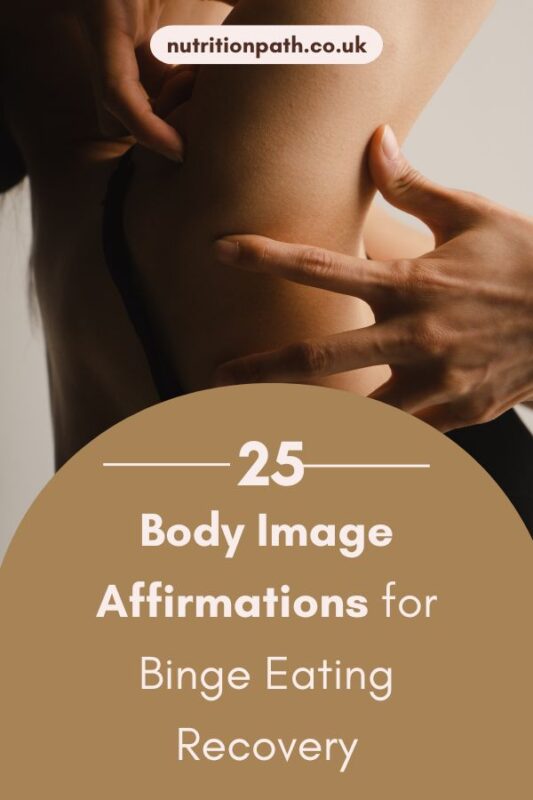
- 25 Body Image Affirmations to Reduce Shame and Support Binge Recovery
- Will Affirmations Alone Stop Binge Eating?
- How to Overcome Negative Body Image and Binge Eating Long-Term
- If Body Shame Is Keeping You Stuck in the Binge Cycle…
- FAQs on Negative Body Image and Binge Eating
The Link Between Negative Body Image and Binge Eating
In my practice, one pattern is impossible to ignore: negative body image and binge eating are deeply connected. I rarely meet someone who struggles with bingeing and also feels genuinely at peace with their body. Much more common is an undercurrent of self-criticism, comparison and shame.
It often starts with a simple thought: “I hate my body.”
That thought quickly turns into: “I need to fix this.”
And from there, it becomes: “I’ll start again Monday.”
This is where the binge–restrict cycle begins.
When body dissatisfaction rises, restriction usually follows. Sometimes it’s obvious — cutting calories, skipping meals or eliminating foods. Sometimes it’s subtle like trying to “be good,” eating as little as possible, or compensating after eating something “bad.” On the surface it feels like control. Underneath, it’s punishment.
But restriction increases food preoccupation and cravings. Add body shame to the mix, and food becomes both comfort and rebellion. The result? Loss of control, guilt, and renewed promises to restrict again. Read more about overcoming sugar cravings here.
Comparison pours fuel on the fire. Social media and unrealistic body standards reinforce the belief that your body isn’t enough. Dissatisfaction leads to dieting. Dieting leads to bingeing. And the cycle continues.
Does Negative Body Image Cause Binge Eating?
Yes, negative body image is strongly associated with binge eating. Body dissatisfaction increases emotional distress and restrictive dieting, both of which raise the risk of binge episodes. While it is not the only influence, it is a significant maintaining factor.
When I see people that feel ashamed of their body in my UK and online nutritional clinic, they are more likely to engage in extreme or rigid dieting, which increases the risk of overeating later. Shame doesn’t create sustainable change. It creates swings between control and chaos.
The difficult truth is this: as long as your relationship with your body is rooted in criticism and rejection, your relationship with food will likely feel unstable too. You cannot consistently nourish a body you are trying to shrink out of self-disgust.
This doesn’t mean you have to love your body overnight. But it does mean that reducing body shame is not just a “nice extra”, it’s often a crucial part of stopping binge eating for good.

Why Body Shame Triggers the Binge–Restrict Cycle
Negative body image doesn’t just influence how you feel, it has real psychological and behavioural consequences that make binge eating far more likely. Research published in journals such as Appetite and Eating Behaviors consistently shows that body dissatisfaction is very much linked with disordered eating, including emotional eating, chronic dieting and binge episodes. When you break the cycle down, a few key mechanisms are at work.
1) Body shame increases emotional distress
Body shame isn’t just a passing thought, as it activates stress, anxiety and harsh self-judgment. A survey of 300 women by Glamour Magazine found that, on average, women have 13 negative body thoughts daily—nearly one for every waking hour. And a whopping 97% of women admit to having at least one “I hate my body” moment each day. That’s alarming.
But it’s not just women, who struggle with body image concerns and dissatisfaction.In fact, the Australian Psychological Society estimates that body image dissatisfaction in men has tripped from 15% to 45% in the past 25 years!
When the nervous system feels overwhelmed, the brain looks for something that will quickly reduce discomfort. Food and especially highly palatable, energy-dense foods can temporarily boost dopamine and provide short-term comfort. The relief is real, but it’s brief. And it’s even more noticed in ADHD, you can read more about it here.
2) Emotional distress increases the desire for comfort
When people feel stressed, lonely or inadequate, they tend to gravitate toward behaviours that soothe or reward them, which for many people is eating. A large study on emotional eating suggests that individuals with higher body dissatisfaction are more likely to use food to regulate difficult emotions. In this context, food becomes more than nourishment, it becomes a coping strategy. It helps numb, distract or soften uncomfortable feelings, even if guilt or shame follows afterwards.
3) Restriction increases the drive to overeat
Body shame often leads to attempts to “fix” or control the body through dieting, skipping meals or rigid food rules. While this can feel productive at first, restriction sets up the exact conditions that increase the risk of binge eating.
Physiologically, undereating disrupts hunger and fullness signals, increases hyperfocus on food and intensifies cravings. Psychologically, strict rules create a sense of deprivation. When those rules inevitably break — because they are difficult to sustain — the brain responds with urgency: “Eat now while you can.”
Research from the 4 year longitudinal school study shows that both chronic dieting and body dissatisfaction independently increase the likelihood of binge eating behaviours.
Together, these mechanisms create a powerful loop:
Body shame → emotional distress → comfort eating → restriction → increased cravings → binge eating
This isn’t about lack of willpower. It’s a predictable pattern that occurs when the body and brain are placed under stress.
On another hand, reducing body dissatisfaction and self-criticism may help lower levels of emotional eating and reduce binge eating over time. That’s why improving your relationship with your body is a crucial step towards improved relationship with food as well.
What Are Positive Body Affirmations and Can They Help?
Changing your body image, especially when binge eating is involved, is a process. It often requires support, structure and deeper work around eating patterns and emotional regulation.
But there are gentle ways to begin.
Positive affirmations, particularly body positive affirmations, are powerful mantras repeated individually, aimed at encouraging a positive self-image and self-esteem.
These are not just simple made-up phrases, but they have a solid scientific base.
Research suggests that consistently saying positive affirmations can rewire our brains to believe these positive statements, making us more likely to act in ways that align with them.
This is due to a psychological phenomenon known as ‘self-affirmation theory’. Affirming your values can create a positive psychological response, thus reducing negative thinking and enhancing self-image and self-esteem.
What this means is that by repeating body positive affirmations, you are creating new neural pathways in your brain. That way daily affirmations lead you to develop a more positive mindset and act in alignment with that.
Isn’t it wonderful that by putting a little bit of effort to start with, the mind adjusts to the new, more positive way of thinking about the body?
Equally, this confirms how daily saying and thinking negative thoughts lead us to believe it and adjust actions accordingly (not to mention feeling crappy along the way!).
Benefits of Practicing Positive Body Image Affirmations
Making peace with your body and accepting it can be tricky, especially if you have been batting with your body for years or the majority of your life.
The truth is if you don’t have a positive relationship with your body, even changing your body and feeling healthier may not help you to feel good about your body image.
However, practising body image affirmations can help break negative thought patterns and replace them with positive ones. That way you begin to see yourself in a more balanced light.
Research has also found that affirming statements about one’s physical appearance can lead to increased self-esteem and higher body satisfaction. This in turn can lead to improved mental health and greater self-acceptance.

How to Practice Body Affirmations Effectively
If you’re curious about incorporating affirmations into your routine, the key is consistency and staying real, not perfection.
- Say them out loud when possible. Hearing your own voice strengthens the impact and helps the statement feel more embodied.
- Choose affirmations that feel believable. If “I fully love my body” feels too far away, start with “I am learning to accept my body as it is.”
- Write them down. Keeping a journal or placing reminders around your home can reinforce repetition.
- Pair them with regulation. Take a slow breath before and after saying an affirmation to help your nervous system settle.
- Be patient. These patterns were built over years. Rewiring them takes repetition.
Affirmations won’t eliminate binge eating on their own. But they can help reduce the body shame that often sits at the centre of the cycle and that’s a powerful place to begin.
25 Body Image Affirmations to Reduce Shame and Support Binge Recovery
Self-Compassion Affirmations
- I am learning to treat my body with respect.
- I can be kind to myself, even on hard body image days.
- My body is not a measure of my worth.
- I am more than just a body.
- I am worthy of unconditional love, just as I am.
- Every day, I accept myself a little bit more.
- I am allowed to care for my body without punishing it.
Affirmations for Letting Go of Comparison
- I am not in competition with anyone.
- My body is a reflection of my own unique self.
- I reject unrealistic standards of beauty.
- I don’t need to reach perfection to be enough.
- My body is a vehicle, not an ornament.
- I refuse to let comparison steal my peace.
Reconnecting to the Body Affirmations
- I can trust my body and its signals.
- I am learning to listen to my body with curiosity, not judgment.
- I allow my body to rest when it’s tired.
- I am grateful for how my body moves.
- My body is strong and resilient.
- I honour my body and all that it has given me.
Body Neutrality Affirmations
- My physical appearance does not define who I am.
- I can respect my body even if I don’t love it yet.
- My imperfections make me human.
- I choose to focus on what my body can do.
- I am enough as I am today.
- I am learning to feel more at home in my body.
Will Affirmations Alone Stop Binge Eating?
Affirmations can help reduce body shame and soften harsh self-talk — and that matters. Shame is often one of the strongest drivers of the binge–restrict cycle.
However, affirmations alone are unlikely to stop binge eating if the behaviour is rooted in chronic restriction, emotional dysregulation, ADHD, trauma, or long-standing dieting patterns. In those cases, deeper work is usually needed.
Affirmations are a supportive tool, rather than a standalone solution.
How to Overcome Negative Body Image and Binge Eating Long-Term
If you want sustainable change, the focus needs to go beyond mindset alone:
- Stop extreme dieting and rigid food rules
- Eat regular, balanced meals to reduce restriction-driven urges
- Reduce body checking and comparison behaviours
- Support nervous system regulation (stress, overwhelm, emotional triggers)
- Seek professional support where needed
When body image improves and your body feels consistently nourished and safe, binge urges often reduce naturally.
That’s when real, long-term change begins.

If Body Shame Is Keeping You Stuck in the Binge Cycle…
You don’t have to untangle this alone.
If you recognise yourself in this article, where the body criticism, the comparison, the shame that fuels restriction and then overeating has become your daily life, know that there is a way out. But it’s rarely about more willpower, stricter plans or trying harder.
It’s about addressing the root causes:
- The dieting–binge cycle
- The nervous system dysregulation
- The ADHD symptoms or emotional triggers
- The body image patterns that keep you stuck
This work is a journey and it’s full of nuance. And it’s much easier with the right support.
You can:
👉 Work with me 1:1 to heal your relationship with food, reduce binge eating and rebuild body trust in a sustainable way.
👉 Book a discovery call to explore what’s going on for you and see whether working together feels like the right next step.
Let’s find an approach to body image and food distress together that works for you long term.
FAQs on Negative Body Image and Binge Eating
-
Can negative body image cause binge eating?
Negative body image does not directly “cause” binge eating on its own, but it significantly increases the risk. Body dissatisfaction often leads to restrictive dieting and emotional distress, both of which are strong predictors of binge episodes.
-
Why does body shame trigger binge eating?
Body shame increases stress and self-criticism. When the nervous system feels overwhelmed, the brain seeks relief. Food, especially highly palatable foods, can temporarily reduce distress, which reinforces the binge–restrict cycle.
-
Does dieting make binge eating worse?
Yes. Chronic dieting and rigid food rules increase food preoccupation, cravings and psychological deprivation. Research shows that long-term restriction is one of the strongest risk factors for binge eating behaviours.
-
Can improving body image reduce binge eating?
Improving body image can reduce emotional distress and the urge to restrict, which may lower binge frequency over time. Addressing body dissatisfaction is often an important part of long-term binge recovery.
-
Do affirmations help with binge eating?
Affirmations alone are unlikely to stop binge eating. However, they can reduce body shame and soften harsh self-talk, which may support deeper recovery work when combined with structured support.
Related Resources and Further Reading
Brown, B. (2005). The heart of body shame. Mothers Movement Online. http://www.mothersmovement.org/features/body_image/b_brown_body_shame.htm
Dreisbach, S. (2011, February 2). Shocking body image news: 97% of women will be cruel to their bodies today. Glamour. https://www.glamour.com/story/shocking-body-image-news-97-percent-of-women-will-be-cruel-to-their-bodies-today
Australian Psychological Society. (2013). Body image and the media. InPsych. https://web.archive.org/web/20130328051857/https://www.psychology.org.au/publications/inpsych/body_image/
He, D., Gilcharan Singh, H. K., Alavi, M., Koo, H. C., Fariduddin, M. N., Wee, L. H., & Siau, C. S. (2025). Body image dissatisfaction and disordered eating behaviors in Chinese female undergraduate students: the mediating role of emotional regulation strategies. Journal of eating disorders, 13(1), 104. https://doi.org/10.1186/s40337-025-01287-x
Stice, E., Hayward, C., Cameron, R. P., Killen, J. D., & Taylor, C. B. (2000). Body-image and eating disturbances predict onset of depression among female adolescents: a longitudinal study. Journal of abnormal psychology, 109(3), 438–444. https://pubmed.ncbi.nlm.nih.gov/11016113/
Cohen, G.L., & Sherman, D.K. (2014). The psychology of change: self-affirmation and social psychological intervention. Annual review of psychology, 65, 333-71 .https://www.semanticscholar.org/paper/The-psychology-of-change%3A-self-affirmation-and-Cohen-Sherman/7fe3234bd35d814caed6e3cf43a3f3ed76ecd6e2
Neagu, A., & Rainer, F.I. (2015). BODY IMAGE: A THEORETICAL FRAMEWORK. https://www.semanticscholar.org/paper/BODY-IMAGE%3A-A-THEORETICAL-FRAMEWORK-Neagu-Rainer/f3be7d0d17267d7e1eedb054af2b9d69f5fdd132