

It’s 7:00 PM, and you’re standing in front of the open cupboards, feeling out of control and reaching for whatever is in front of you. You’re eating chips or sweets straight from the packet, barely tasting them, moving on autopilot.
There’s a heavy, familiar knot of shame tightening in your stomach because you promised yourself just this morning that today would be different. You swore today you’d “stick to the plan.” Instead, you feel like an absolute failure, wondering why you can’t just find the discipline to stop.
Time to drop the guilt and shame if you binge eat with ADHD. It may be less about willpower and more about your unique brain. In fact, if you have ADHD, you are actually using an immense, exhausting amount of willpower just to function, focus, and mask your symptoms all day long.
By the time evening rolls around, your brain is physically and chemically depleted. You’re not bingeing because you’re out of control or are weak, you’re bingeing because your brain is running on empty and desperately trying to survive the night.
While we looked at the broad neurological link between ADHD and binge eating in my main guide, [I Can’t Stop Binge Eating With ADHD — What’s Actually Going On?], now we will look at the three specific biological traps making you feel like you lack control. Let’s strip away all the judgments and look at the actual science of what may be happening inside your nervous system and your unique beautiful brain, especially if you routinely binge eat with ADHD.
Milda is an MSc Nutritional Therapist, specialising in binge eating, disordered eating and ADHD support. She is running a busy online practice with clients in UK (including Bath, Bristol & Frome, and globally)
1. Why does ADHD influence binge eating?
To understand why your brain drives you to the fridge and cupboards with such urgency, we have to look at how it experiences the world. In fact, a 2024 study published in the Brazilian Journal of Psychiatry highlighted that adults with ADHD are actually four times more likely to struggle with eating disorders, such as binge eating, compared to those without ADHD.
In a neurotypical (non-ADHD) brain, dopamine functions like a steady, reliable drip-irrigation system. It releases a little splash of satisfaction when they finish a mundane task, reply to an email, or check an item off a to-do list. This steady baseline keeps their mood stable and their impulses in check.
An ADHD brain, however, lives in a constant, painful state of “dopamine drought.”
Because your baseline levels of this focus-and-reward chemical are naturally lower, everyday tasks don’t give you that same chemical “pat on the back.” Sending that email doesn’t feel satisfying, it just feels exhausting. To compensate, your nervous system is constantly scanning its environment, frantically asking: Where can I get a hit of chemical stimulation right now?

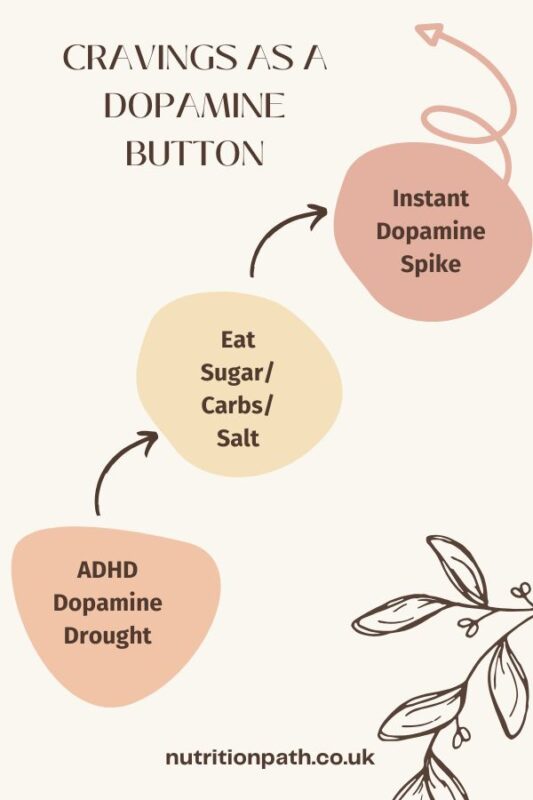
Cravings As The Ultimate Dopamine Button
The reality is that in our modern world, food is the fastest, cheapest, and most reliable dopamine button available.
When you eat quick foods, specifically things high in sugar, simple carbohydrates, and salt, your brain gets an immediate, massive surge of dopamine. It’s a chemical firework display.
Clinical data has shown that when baseline dopamine D2 receptors are reduced in reward-related brain regions, highly palatable foods (like sugar) trigger an immediate dopamine release in the striatum. BUT, as those levels drop afterward, it plunges the brain back into a low-dopamine state that triggers further impulsive, overeating behaviour to reset the system, hence the crash that follows after.
When you binge eat with ADHD, it is almost never a food craving, but rather a stimulation craving. Your brain has learned that if it forces you to open that packet of biscuits, it will get the chemical rescue it is so so desperate for.
So when you blame yourself for having “no self-control,” remember that you are fighting an uphill battle against a survival mechanism. Your brain is simply trying to self-medicate its chemical deficit the quickest way it knows how. It’s not a moral failing, but rather neurobiology.
2. What is the connection between ADHD interoception and overeating?
Have you ever been so hyperfocused on a project, a video game, or a book that hours flew by without you noticing? You didn’t realize you needed the bathroom, you didn’t notice your neck aching, and you certainly didn’t feel hungry. Then, the moment you finally snap out of it, you feel like you are absolutely starving.
This happens because of a neurological glitch in a hidden sensory system called interoception. You can think of it as your brain’s internal dashboard that can process messages sent from your organs that tell you what your body needs to maintain balance (food? Water? A rest?).
In a neurotypical person, this system works like a gradual staircase. They feel their hunger build slowly from a 2/10, to a 4/10, and by a 5/10, they think, “I should probably make a sandwich.”
But for an ADHDer, that internal dashboard is often muted. Research published in Frontiers in Psychiatry shows that individuals with ADHD show significantly altered neural processing of internal bodily signals, which directly impairs their awareness of physiological states like hunger and satiety, meaning ADHDers may have these internal signals that are not that strong as a neurotypical person.
Because your brain doesn’t register the quiet, early signals, your perceived hunger stays at a flat 0/10 all day long. You go about your day completely unaware that your biological energy stores are emptying. Check out my simple guide on how to eat regularly with ADHD.
This is why traditional diet advice like “just practice mindful eating” or “listen to your body” feels incredibly frustrating and useless when you have ADHD. You can’t listen to a body signal that your brain isn’t delivering until it’s already an emergency. Once again, the resulting binge isn’t a lack of discipline, but rather an involuntary biological reaction to delayed hunger.
3. Why do ADHD medications trigger evening binge eating?
If you take stimulant medication for ADHD, you might notice a clear difference in cravings and urges to eat compulsively once the medication starts to wear off. During the day, you feel completely in control and maybe you even forget to eat! But by 5:00 PM or 6:00 PM, an overwhelming, uncontrollable hunger takes over, and you find yourself clearing out the kitchen cabinets.
This isn’t a failure of the medication, nor is it a personal failure. It is a highly predictable physiological response known as the stimulant rebound effect.
While stimulants are highly effective at helping your brain manage focus and impulse control, they are also potent appetite suppressants. Clinical reviews show that decreased appetite affects roughly 80% of individuals taking stimulant medications, altering the brain’s internal signals regarding food reward and satiety.
When you add this together with the interoception issues we just discussed, a classic daily medication loop is set:
The Daily ADHD Stimulant Medication Loop
1.The Morning Rush:8:00 AM.
You wake up with low dopamine, and lower executive function. Making a balanced breakfast feels like climbing a mountain, so you skip it or have a piece of toast, take your medication, and head out the door.
2.The Daytime Mute:12:00 PM.
Your medication is at its peak. Your focus is sharp, but your biological hunger signals are completely muted. You forget to eat lunch entirely, or you push through it because you’re “in the zone” and you don’t want to walk away.
3.The Double Crash:5:00 PM.
The medication begins to wear off. Two things happen simultaneously: the appetite-suppressing effect vanishes, and your brain’s executive function drops rapidly. You realise that you’re exhausted and depleted.
4.The Biological Storm:6:00 PM onwards.
Suddenly, your brain registers that it has been running on zero fuel all day while your impulse control is at its lowest point. Primal, biological starvation takes over and you find yourself right at the fridge.
—
When you are caught in this loop, willpower stands zero chance (because it requires both glucose and rest for resilience). Your logical prefrontal cortex has clocked out for the day, and your starved body is demanding immediate, fast-acting energy to keep going.
I see this pattern in my UK and online nutritional therapy clinic with my ADHD clients all the time and daytime undereating, whether it’s intentional or completely accidental due to medication, is one of the primary behavioural triggers for intense evening overeating and bingeing episodes.
You aren’t bingeing because you have no willpower or are weak, you binge eat with ADHD because your body is trying to catch up with a day’s worth of missed calories in a single hour, at the exact moment your brain is chemically least equipped to stop it.

Working With Your Biology, Not Against It
If you take only one thing away from this article, let it be this: traditional diet advice is not built for your beautiful ADHD brain.
When well-meaning professionals tell you to “just eat mindfully,” “track calories,” or “use a little more discipline,” they are handing you a neurotypical map for a neurodivergent territory. Those tools rely entirely on a steady baseline of dopamine, a perfectly predictable medication window, and an internal body dashboard that speaks at a normal volume. For an ADHDer, trying to follow that advice is like trying to drive a car with no fuel, which is exhausting, frustrating, and ultimately set up to fail.
To finally break the cycle of evening binge eating, you have to stop fighting your biology. You cannot shame, restrict, or willpower your way out of a chemical deficit or an empty fuel tank if you binge eat with ADHD. True healing happens when you learn to proactively feed your brain the dopamine it craves, structure your meals around your medication windows, and bridge the gap left by your internal hunger signals.
Ready to Stop Fighting Your Biology?
Trying to force a neurotypical framework onto an ADHD brain is exhausting and it clearly hasn’t worked until now. Healing your relationship with food requires a neuro-nutrition approach that stabilises your dopamine, manages your medication windows, and respects your unique nervous system.
As a Registered Nutritional Therapist specialising in ADHD and disordered eating with clients all over the UK and globally online, I help you move past the guilt and build a practical, structured way of eating that works with your brain, not against it.
You don’t need more discipline. You just need a strategy that honours who you are and the beautiful brain that you have.
FAQs About ADHD and Binge Eating
-
Why do I lose control around food with ADHD?
If you binge eat with ADHD is primarily influenced by a chemical need for stimulation and a lack of executive function, not a personal failure. Because ADHD brains have fewer active dopamine receptors, the brain experiences a chronic deficit in satisfaction. Highly palatable foods provide an instant chemical surge, causing the understimulated ADHD brain to impulsively drive eating behaviors to self-medicate.
-
Why do ADHD medications create evening binge eating?
Stimulant medications for ADHD influence evening binge eating due to the “stimulant rebound effect.” Stimulants heavily suppress appetite during the day, which often causes individuals to accidentally skip meals. When the medication wears off in the late afternoon, the appetite suppression vanishes instantly while executive function crashes, leaving the body in a state of severe biological starvation.
-
How do I stop impulsive eating with ADHD?
To stop impulsive eating with ADHD, you must transition from a restrictive dieting mindset to a proactive, neuro-nutrition strategy. This involves establishing a structured eating schedule to outsmart poor interoception, consuming adequate protein early in the day to stabilise neurotransmitters, and building a non-food “Dopamenu” to satisfy the brain’s stimulation needs.
-
What is the connection between ADHD interoception and overeating?
Interoception is the nervous system’s sensory tracking of internal body states, such as a growling stomach or a full bladder. Because ADHD brains struggle to filter sensory data effectively, these subtle, gradual hunger signals are often completely missed during periods of hyperfocus. As a result, an individual may transition instantly from feeling completely fine to experiencing an extreme, frantic hunger emergency.
References and Further Reading
- Appolinario, J. C., de Moraes, C. E. F., Sichieri, R., Hay, P., Faraone, S. V., & Mattos, P. (2024). Associations of adult ADHD symptoms with binge eating spectrum conditions, psychiatric and somatic comorbidity, and healthcare utilization. Revista brasileira de psiquiatria (Sao Paulo, Brazil : 1999), 46, e20243728. https://doi.org/10.47626/1516-4446-2024-3728
- Johnson, R. J., Gold, M. S., Johnson, D. R., Ishimoto, T., Lanaspa, M. A., Zahniser, N. R., & Avena, N. M. (2011). Attention-Deficit/Hyperactivity Disorder: Is it time to Reappraise the Role of Sugar Consumption?. Postgraduate Medicine, 123(5), 39-49. https://doi.org/10.3810/pgm.2011.09.2458
- Poulton, A. S., Hibbert, E. J., Champion, B. L., & Nanan, R. K. (2016). Stimulants for the Control of Hedonic Appetite. Frontiers in pharmacology, 7, 105. https://doi.org/10.3389/fphar.2016.00105
- Kutscheidt, K., Dresler, T., Hudak, J. et al. Interoceptive awareness in patients with attention-deficit/hyperactivity disorder (ADHD). ADHD Atten Def Hyp Disord 11, 395–401 (2019). https://doi.org/10.1007/s12402-019-00299-3